
It’s no secret that our environment is changing rapidly. Since the Industrial Revolution, Earth’s global temperature has increased by around 2°F. While this number may seem insignificant, that subtle temperature increase has already had detrimental effects on our planet.
Global warming occurs when greenhouse gases like carbon dioxide (CO2) and methane are released into the atmosphere. Human activity like burning fossil fuels (oil, coal, natural gas) is responsible for the release of these gases. Greenhouse gases trap the sun’s heat within the atmosphere, warming the earth. Global warming leads to climate change, which is a broad term that encompasses all of the environmental effects caused by increased global temperature. Changes in rain and snowfall patterns, intense heat waves, and rising sea levels caused by melting glaciers are all examples of climate change.
The Intergovernmental Panel on Climate Change (IPCC) is a United Nations body that assesses the effects of climate change. The IPCC states that:
“The scientific evidence is unequivocal: climate change is a threat to human wellbeing and the health of the planet. Any further delay in concerted global action will miss the brief, rapidly closing window to secure a livable future.”
All life will be affected by climate change, however many will be affected disproportionately, largely due to geographic location. According to the United Nations, lower-lying atoll nations in the Pacific like Kiribati and the Marshall Islands are being hit hardest. Many islands are only 6 feet above sea level. Severe storms and rising sea levels have forced many people away from their homes. Flooding in West and Central African nations like South Sudan, Nigeria, and Chad have all faced serious issues regarding flooding. In 2022, 2.5 million people in Nigeria and 900,000 people in South Sudan were displaced or otherwise affected by severe flooding.
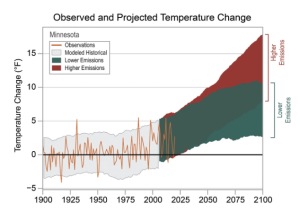
Between 1895 and 2024, the average annual temperature in Minnesota has increased by 3.2°F, 1.2°F more than the global average.
According to the University of Minnesota:
“The top 10 combined warmest and wettest years on record in the state have all occurred since 1998, and Minnesota has experienced the most significant winter warming of any state in the contiguous United States.”
In Minnesota, temperatures are projected to increase by 3.8-4.5°F throughout the next 25 to 30 years and the timing and intensity of precipitation is expected to change drastically as well. Shorter snow seasons, heavier rain, and long, dry summers are all predicted.
Our winters are warming the fastest; the average winter temperature has increased by 5.4°F throughout recent decades. Warmer winters means less frequency
of snowfall and far less snow coverage than what we’re accustomed to. These changes in our climate are causing serious issues; flooding, extreme weather, and wildfires are just some of the effects global warming has on our state.
Southwest students have many concerns surrounding our changing climate. Alice Andersson-Stern (‘28) noted that “It used to snow earlier in the year. Now, it feels like it doesn’t start until a lot later.” Many, including Sophie Jones (‘28), reminisce on when it began to snow earlier in the year. “I remember when it used to snow on Halloween.” Khaled Mohamed (27’) mentions the exceptionally mild winter from 2024 to 2025. “Last winter I don’t think we got any snow until January.”
Addy Babler (‘28) says that winter weather is important – not just environmentally, but even from a cultural aspect. “Weather is a huge part of people’s identities. I have a lot of anxiety about the future.” Eli Andrews (‘28) recognizes that the lack of snow can be convenient, but the reason for the warmth overshadows her gratitude. “As much as I appreciate not having to commute in heavy snow, the lack of snow we’ve had has made me really worried about our future. Minnesota is supposed to have snow.” Leo Johnston (‘28), especially uneasy about our changing winters, offers a call to action. “It’s an issue nobody takes as seriously as they should. It will impact everyone. The actions we can take individually to tackle climate change don’t have to be daunting.”
So what can you do?
One of the simplest things you can do as an individual is watching your product consumption. Overconsumption of goods leads to overproduction, and overproduction adds even more pollutants to our environment. According to Columbia University, production and use of household goods and services is responsible for 60 percent of global greenhouse gas emissions. Reusing what you already have and opting to buy second-hand can significantly reduce your personal carbon footprint.
However, in order for major progress to be made, there needs to be a policy change. We all have to advocate for policies like carbon pricing and emission limits. Boycotts can also heavily influence corporate behavior if enough people participate in them. By not buying from corporations that ignore their impacts on the environment, they may feel pressured to make a change if enough profit is lost. Serious action must be taken soon. If we do, there’s still a chance to stop and even possibly reverse climate change, but it’s up to us to take those steps.